
Understanding the DPPt Pokéradar
Mastering the Pokéradar is not just about understanding how it works, it is about learning how it behaves in each game, because every version operates slightly differently.
Introduced in Pokémon Diamond, Pearl, and Platinum, the Pokéradar is one of the most hands-on and unforgiving shiny hunting methods in the series. The core idea is simple for shiny hunters: build a chain, improve your odds, and look for the shiny patch. In practice, though, every step in the grass becomes a decision that can either extend your chain or end it instantly. However, as unforgiving as the Pokéradar can be, it is also incredibly fun and addictive.
If you have already worked through the core Pokéradar guide, you should have your preparation handled and a clear understanding of how chaining works. This guide builds on that foundation and focuses specifically on the Diamond, Pearl, and Platinum version of the Pokéradar.
If you are jumping into this article first, that is fine too. Just know that success with the Pokéradar does not come from luck alone. It comes from preparation, recognizing patterns, making disciplined choices, and understanding why chains break in the first place.
Let’s break down how the Pokéradar works in Diamond, Pearl, and Platinum, and what you need to do to keep your chain alive.
More Articles



Please note that some external links on this page are affiliate links, which means if you click them and make a purchase we may receive a small percentage of the sale.
What You’ll Need Before You Start
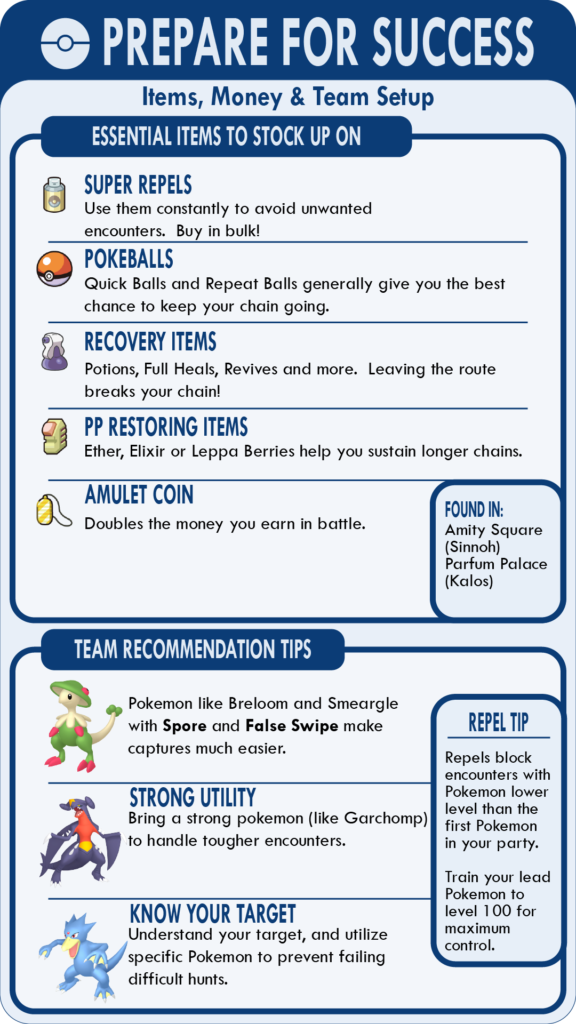
If you are jumping into the Pokéradar without going through the full setup guide, here is a quick checklist to make sure you are ready to build a chain without unnecessary interruptions:
- A large supply of Super Repels
- Plenty of Poké Balls, especially Quick Balls and Repeat Balls
- A well-prepared team
- A high-level lead Pokémon
- Basic recovery and PP items
The Pokéradar is much easier to manage when your bag and team are prepared before the chain begins.
Obtain the Trainer Counter Pokétch App
After seeing every Pokémon in the Sinnoh regional Pokédex, Professor Oak will give you the incredibly helpful Trainer Counter Pokétch app.
Because it is visible on the bottom screen, the Trainer Counter app gives you an easy way to track your Pokéradar progress. It shows your current chain at the top and your three longest chains at the bottom.
In Diamond, Pearl, and Platinum, the Trainer Counter app can also tell you when your chain has failed before the wild Pokémon appears. If the chain breaks as you enter a grass patch, your current chain will disappear from the Pokétch app.
While this app is not essential for chain success, it is one of the most helpful tools in your shiny hunting arsenal.
Clear the PC
If you follow my advice and try to catch every Pokémon you encounter, it is a good idea to make sure you have plenty of space in your PC before the hunt begins. My recommendation is to clear out at least two boxes, giving you enough room for the Pokémon you catch along the way and the shiny variant you are hunting.
Breaking Your Chain
If you have all of that in place, you are ready to start chaining. From here, success comes down to execution, consistency, and understanding how the Pokéradar behaves in Diamond, Pearl, and Platinum.
Before starting your chain, it is important to understand what to avoid so you do not accidentally break it. These are the most common actions and situations that will break your chain:
- Turning off the power. If you need a break, close your DS instead.
- Traveling too far away from the shaking patches of grass, causing all shaking tiles to leave the screen
- Using your bike
- Encountering a wild Pokémon you were not chaining
- Encountering a wild Pokémon in non-shaking grass
- Having no available grass patches shake
- Selecting “Run” during a battle
- A Pokémon evolving
It should be noted that avoiding all of the listed criteria does not guarantee your chain will continue. Part of what makes the Pokéradar so unforgiving is that even perfect execution is not always enough. Whenever you enter shaking grass using the Pokéradar, there is at least a 2% chance that the chain will break at random.
Additionally, saving your game will not save your current chain. Because of that, it is not recommended to save once your chain is already underway, especially if the chain is getting large. Only save again after you have achieved your desired outcome, which is finding and catching the shiny Pokémon you are hunting.
Beginning the Chain
Before activating the Pokéradar, try to stand near the center of the largest available grass patch on the route. The more grass tiles surrounding you, the more valid options the Pokéradar has when it generates shaking patches. Starting near an edge gives the game fewer useful tiles to work with.
Once you are near the center of the grass, use a Repel and save the game.
There are three distinct grass animations you may notice in Diamond, Pearl, and Platinum, though when you begin your chain, you will only see two of them: fast grass and slow grass.
Fast grass shakes briefly and appears more “flashy.” This type of grass is more likely to include rarer Pokémon from that route’s encounter table.
Slow grass shakes for a longer period and usually indicates more common Pokémon that are native to the area.
These animations are important, and you will want to pay close attention to the type of patch you first enter. Switching between fast and slow grass is one of the ways you might break your chain, so after entering either fast or slow grass, you will want to consistently enter that same type of shaking grass for future encounters.
The third type of patch you may encounter later in your chain is shiny grass. This patch sparkles and has a longer animation, making it slightly easier to identify. Entering this patch guarantees the shiny Pokémon you are chaining.
When you initially activate the Pokéradar, you should focus on two things: where the grass is located and how each patch is shaking. In Diamond, Pearl, and Platinum, the Pokéradar behaves almost like a memory game because the grass animations are temporary. From the patches that shake, select one and step into it.
Congratulations, you have begun your first encounter. If the Pokémon you encounter is one you want to hunt, you should either catch or knock it out to continue your chain. However, do not run away, as doing so will immediately break your chain.
If the Pokémon you encounter is not your intended target, you can soft reset the game by pressing Start + Select + L + R simultaneously. This will return you to your previous save, allowing you to try again without losing resources.
Now, let’s assume you found a Pokémon you want to hunt. What you do next is important and directly affects your chances of continuing the chain. As a general rule, it is best to catch the Pokémon whenever possible, since catching provides a higher chance of your chain continuing. Knocking out the Pokémon still gives you a strong chance, but losing that extra boost can lead to unnecessary chain breaks.
Before you make that decision, it helps to understand the math. The table below shows how your choice, along with the distance of the grass patch, impacts your chances of continuing the chain.
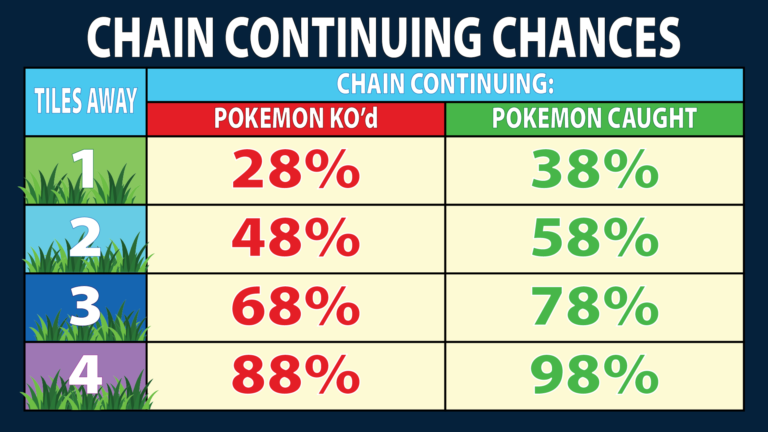
Let’s break down these graphics so they are simple to understand.
The first thing you will notice is that the nearer the shaking grass is, the lower the chance your chain will continue. For this reason, it is recommended that you always enter shaking grass tiles that are four tiles away from your character.
Next is the statistical breakdown of how your actions influence the Pokéradar. Capturing your target gives you a higher chance that your chain will progress, which is why I recommend capturing your target consistently whenever possible. However, the boosted chance of your chain continuing after a capture only applies to the next immediate roll.
Continuing the Chain
This is usually the point where people start to feel intimidated by the Pokéradar, because taking your chain from 0 to 40, or even beyond, can feel extremely daunting. Here are a few tips that should help make the process feel more manageable.
Avoid Edge Patches
My first tip is to never enter an edge patch of grass.
When you use the Pokéradar, the game selects four tiles: one tile that is 1 tile away from the player, one that is 2 tiles away, one that is 3 tiles away, and one that is 4 tiles away. The player acts as the center of this range.
Whenever you enter an edge patch, you decrease the number of grass tiles the Pokéradar can trigger after the encounter. As a result, the game has fewer valid options available, which increases the likelihood of your chain breaking.
Be Patient, and Don’t Be Afraid to Reroll
My next tip is to be patient with the radar, and do not be afraid to reroll if the patch that is four tiles away from you is in a bad position, especially if it is on an edge.
You can reroll your Pokéradar by taking 50 steps in the grass. After those 50 steps, you can use the Pokéradar again to reroll the shaking tiles.
The tradeoff is that rerolling removes the temporary chain-continuation boost you gained by catching the previous encounter, but sometimes that cost is worth it.
Patience generally pays off because the higher the chain, the more likely you are to encounter a shiny Pokémon.
To put it simply, if the four-tile patch is on an edge or uses the incorrect animation, you should consider rerolling.
Move in “Lanes”
If you need to reroll the grass and still need to build up your steps, my advice is to move in lanes.
Because the Pokéradar in Diamond, Pearl, and Platinum operates almost like a memory game, look for a straight, shaking-grass-free lane where your character can safely pace back and forth. This can be either north to south or east to west.
If you run in circles, you may forget where the shaking tiles were, which increases the likelihood of accidentally stepping into the wrong patch and breaking your chain.
Reaching a 40 Chain
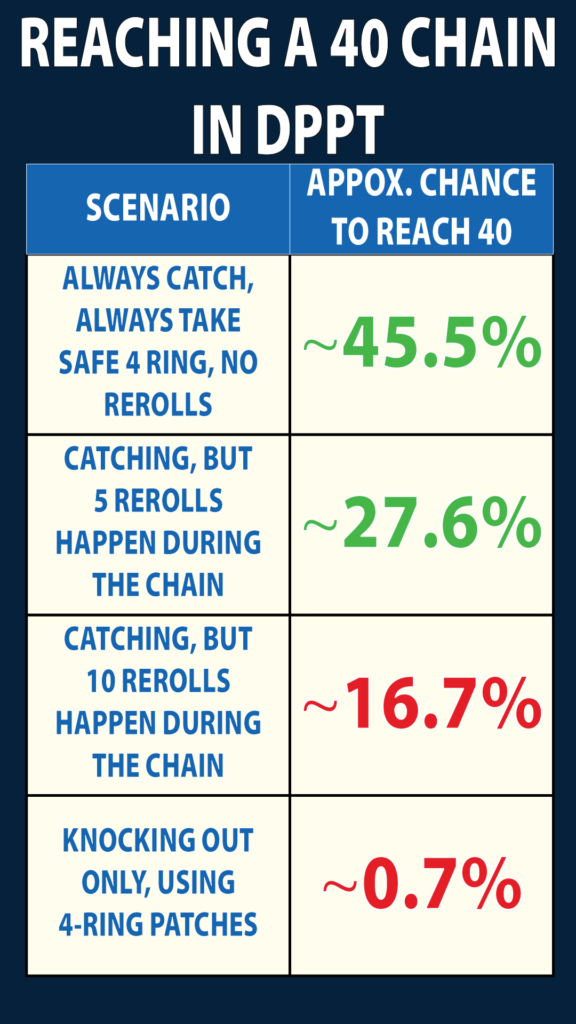
Even when played correctly, reaching a 40 chain is not guaranteed. If you consistently catch your target and enter safe patches four tiles away, your chance of reaching a 40 chain is roughly 45% under ideal conditions. That number drops whenever you reroll the radar, make a risky movement, or are forced into less favorable patches, which is why patience matters so much.
Given how rare reaching a 40 chain can be, once you reach that point, you do not want to encounter any more Pokémon except for the shiny variant. Instead of entering grass or knocking out more Pokémon, you will want to reroll the grass patches until you see the special shiny animation.
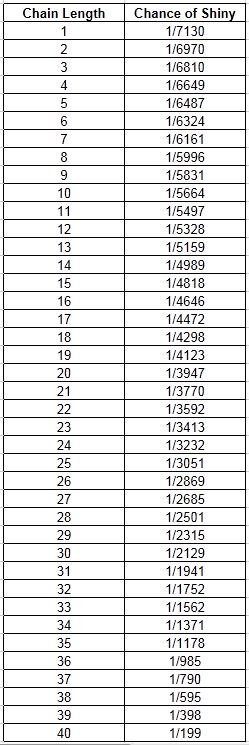
At a chain of 40, each individual shaking patch has roughly a 1 in 199 chance of being shiny. Since the Pokéradar can generate multiple patches at once, each full radar activation gives you roughly a 1 in 50 chance of seeing a shiny patch.
Final Thoughts
The Pokéradar in Diamond, Pearl, and Platinum is intimidating at first, but it becomes much easier as you make careful decisions.
Your goal is to build your chain carefully, avoiding unnecessary risks by rerolling the radar rather than forcing a bad patch. As you stick to safe four-tile patches, avoid edge grass, and stay consistent with the shaking grass animation, building your chain should become a lot easier.
However, the Pokéradar can still break your chain for reasons completely outside your control. That is frustrating, but it is also what makes the shiny grass feel so rewarding. This method asks for patience, attention, skill, and a little bit of trust that the reward will be worth the grind.
Once you hit a 40 chain, the way you hunt changes. Instead of advancing the chain, you will want to keep resetting the Pokéradar until a shiny patch appears.
While the Pokéradar can be unforgiving, it is one of the most satisfying shiny hunting methods Pokémon has ever had. With the right preparation and a disciplined approach, reaching a 40 chain is not guaranteed, but it is absolutely within reach.